Thursday, January 20, 2022

Word of the Day -- Haecceity

Full disclosure here -- I had NO idea of this word until I read it in my inbox today.  I love discovering new words, especially if they come out of left field and are something that I didn't even know there was a word for, much like...


Haecceity -- The property of being a unique and individual thing.

Haecceity is a deeply philosophical concept attributed to Scottish Catholic priest and university professor John Duns Scotus. He defined it as a non-qualitative property of a substance or thing that is responsible for its individuation and identity, such as a particular person’s unique identity. Interestingly, Scotus is also where the term “dunces” originated from. His opponents equated Duns’ followers, who argued against Renaissance humanism, to dullards incapable of scholarship.

This word stems from the medieval Latin “haecceitas.” It comes from the Latin “haec,” feminine of “hic,” meaning “this.”

It's still something that I'm trying to come to terms with, this word.  It seems to me, at least, that it is something that describes something's "essence" in other words.  What do you think?

 P.S. I chose this image because I have no idea how to quantify, in imagery, an essence.  :-)



Wednesday, January 19, 2022

Word of the Day -- Tergiversation

This is one of the 7 dollar words as my mother used to call them.  You know, those words that are big, fancy, and you have no frigging clue what they mean.  I ran across it in a new puzzle today, and it stumped both me and my wife.  But if you want to impress the barista at Starbucks, give this a go:

Tergiversation -- evasion of straightforward action or clear-cut statement; equivocation.

Now I knew what equivocation means, my wife says I do that all the time.  I hedge my answers or bets, so to speak.  You never want to paint yourself into a corner I say.  :-) 

The roots of tergiversation are about an unwillingness to pick a course and stay on it. The Latin verb tergiversari means "to show reluctance," and it comes from the combining of tergum, meaning "back," and versare, meaning "to turn." (While versare and its related form, vertere, turn up in the etymologies of many English words, including versatile and invert, tergum is at the root of only a few, among them tergal, an obscure synonym of dorsal.) While the "desertion" meaning of tergiversation is both older and a better reflection of the meanings of its etyma, the word is more frequently used as a synonym of equivocation. The related verb tergiversate is a somewhat rare synonym of equivocate. 


Short Rules for Training in Castles and Crusades


If you saw yesterdays blog entry (Training in Castles and Crusades) I mentioned making rules for training. Well, rather than actually working on something productive, I decided to make a few house rules for training. So here ya’ll go.


Rule One: All classes can train to become better.

Rule Two: To train, a character from 1st to 9th level must find someone of the same class who is at least three levels higher.

Rule Three: Training beyond 10th level requires a teacher at least 5 levels higher than the character.

Rule Four: A character earns experience points while training,

Rule Five: The character can earn up to ½ the experience points necessary to attain the next level.

Rule Six: The character can not advance to the next level through trained experience points. At least the last point needed to attain a level should be done adventuring. (probably change to 25%ish)

Rule Seven: Training takes time; a lot of time. Training is measured in weekly increments. Multiply the level of the character by 100 and that is the number of experience points that can be earned in a week of training.

Rule Eight: Training costs money. Every experience point costs 1gp x level. (This should be adjusted by campaign or role-played.)

Advantages present an issue as they are not in the core progression. As such....

Advantages usually come with a few prerequisites; an attribute score, a race, or a BtH. 

Rule One: As Rule 1-3 above.

Rule Two: A character earns an advantage while training.

Rule Three: Advantages with race and attribute score prerequisite cost training xp. These xp requirements are in addition to any xp needed to gain a level. these are considered separate xp progressions. At least 1/2 these xp have to be acquired in training.

    1st Advantage     2000xp

    2nd advantage     8000xp

    3rd advantage     32000xp

    4th advantage     128000xp

Rule 4: See Rule Seven and Rule Eight above for costs and time.

Rule 5: Advantages requiring a BtH progress with the level associated with that BtH. 

Rule 6: To determine xp cost to progress, divide the associated level by 1/2. That is the xp cost.

Rule 7: At least 1/2 the xp needs to be acquire in training.

There, that was easy.

Please comment, addend, etc 

Next we need a random occurrence of interest chart for what can happen while the characters take some 'down time' training.

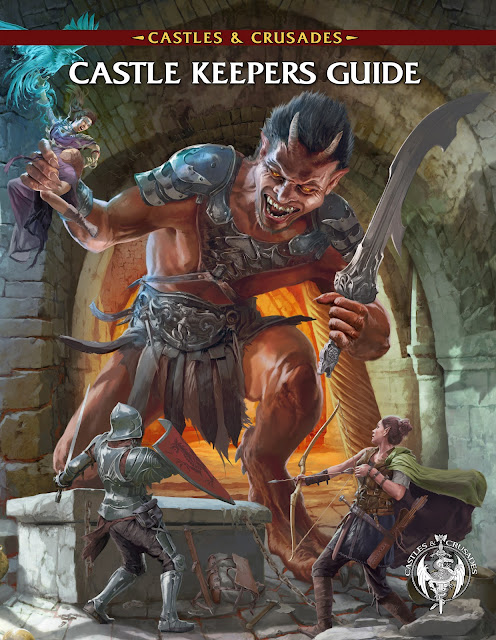
That should be in the Castle keepers Guide


Tuesday, January 18, 2022

Word of the Day -- Tome

I wanted to do this one simply because of how our fearless leader, Steve, continues to screw up the pronunciation of this word.  It makes sense after you see what it is:

Tome -- A tome is a large or scholarly book.

So we have a book entitled Tome of the Unclean.  It's important to know that Tome is pronounced TOHM.  However, for whatever reason (partly because it kind of fits too) Steve will say Tomb (pronounced ˈtüm), with long Os.  Tomb is an excavation in which a corpse is buried, so it would actually would fit and he knows the difference but for some reason it is just stuck in his head.  You know how it is, once you start with something, it's there.  Just like when I was a kid and would ask my brother is going to do something for me and he would say "Maybe no, maybe not".  And I always thought that meant that he would do it because he always would do it.  

Words are confusing...


Training in Castles and Crusades


I don’t think we have training rules in Castles and Crusades. I can’t check either because my internet is down and the only copy of a Castle Keeper’s Guide I have handy is on the Troll Lord Games server. So, yeah. I should probably remedy that. I probably will not. In any respect, I was listening to a podcast the other day. An ex-Delta team member was speaking to his days of training and learning to become a better combatant. I noted a few things.


First a little summery of one portion of the commentary. The guy had just graduated from his year of training with the SEALs. He and six others, all in their early 20s were sent for yet another training exercise for hand-to-hand combat. An ‘elder’ SEAL, in his mid-40s faced them off. The goal was a knife fight. The older SEAL member beat each and every one of the younger SEALs in under 1 minute each, taking each to the ground before delivering the killing blow. The older SEAL team member had real life combat experience as well as a lot more training. The real-world experiences are what set him apart.  

The point the SEAL member made afterword was very interesting and played into a theory of mine. Training can only take a person so far. Real life experiences or application of the training are where the most significant advances in one’s skills are made. US Army records in WWII and Vietnam also reveal the same thing. Even though training attempts to replicate real world combat, it can’t. I guess that’s where the rubber meets the road. On the other hand, the SEAL team member said that continual training, refinements, and reapplication of what was learned in real world situations was even better. It is the combination of the two that creates true expertise. 


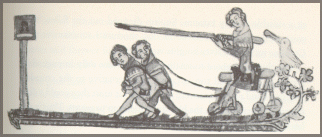
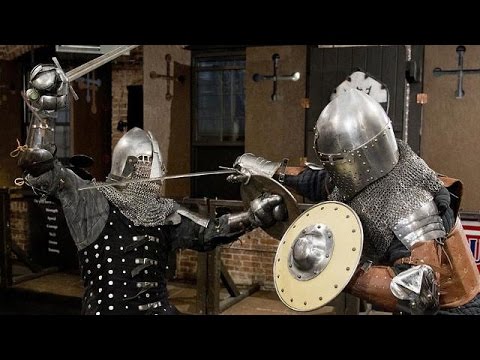
As was the case during the age when swordcraft was widely practiced. Continual training was par for the course for knights and soldiers. This is especially true of standing armies like those Rome or the Persians employed. Most knights went through six years of training and combat before being knighted. Sir William Marshal is said to have trained well nigh unto his death. At seventy he was still fighting trim and constantly trained. There were even academies of the marshal arts found throughout Europe where those who could afford the training, would pay handsomely.

Training plays no real role in many games. Primarily, I think, because it would be boring and consumptive of in-game time (a constant non-issue for me and me alone apparently). I do think training can be used in the game. A simple solution that could hasten level advancement without effecting much of anything is that a character could train up to ½ the experience needed attain the next level. The caveat being the last ¼ experience need to attain level would have to be while adventuring. Costs and time could vary and would need to be worked out.

The training would open a whole new venue of opportunities for the person running the game to create different adventures, sorta slurp up extra coinage the characters may have laying around, and have the characters meet new non-player characters. Sometimes finding the famous thief, swordmastrer or magician to train under could be an adventure. I think this could be easily incorporated into a game and might be something Castle Keepers should be open to. I used to use it all the time but quit several decades ago for some reason. I think it high time I bring it back.  


Monday, January 17, 2022

Word of the Day -- Calumet

Came across this one in one of the puzzles this morning.  Had no idea on it.   Usually I can at least guess at a word, either because I've seen or heard it, or can suss out something about its derivation.  But honestly, I was totally stymied:

Calumet -- a highly ornamented ceremonial pipe of the American Indians.

The calumet has long been an important component of the ceremonies of Native American groups, but the first inhabitants of the Americas did not give the venerated pipe (also known as the "peace pipe") that name. English speakers borrowed "calumet" from American French, which had carried it from the dialects of France to North America. "Chalumet," the French ancestor of "calumet," traces to the Latin calamus and the Greek kalamos, both of which mean "reed" or "pen." French baron Louis-Armand de Lom d'Arce La Hontan, who explored North America in the 17th century, noted that French speakers had applied "calumet" to the highly ornamented clay pipes of Native Americans by the 1670s; English speakers followed suit before the turn of that century. (merriam-webster)


Friday, January 14, 2022

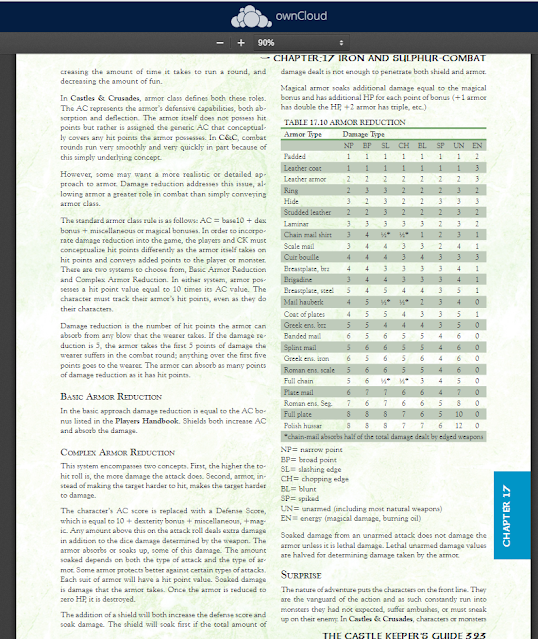
Damage Reduction for Armor


It was asked so I had to address. Yes, Castles andCrusades has damage reduction rules for armor. It is an optional rule offered in the Castle Keepers Guide. There are so many optional rules in the Castle Keepers Guide that I feel compelled to give you all a brief overview of some. But first… damage reduction.


I like damage reduction for armor. It has a nice feel to it. Armor is, I think, for the most part the last line of defense when in a fight. It is passive in nature and not actively used in offense or defense. It is, more or less, the last line of defense. Once the armor has been struck all other defensive moves have been used. Parrying, dodging, deflecting, etc. have failed. The blow is struck. Now it’s the armor’s turn to do its work to mitigate any damage from a blow. Sometimes it works well, other times, not so much.

Damage reduction for armor feels more real to me. The static nature of combat all feels a little too contrived at times. Though it is functional, useful, efficient, and an excellent mechanic, the ‘to hit’ roll and armor class have always felt a little ‘off.’ One of the reasons is that it is basically a mechanic derived from chit-based wargames. The mechanic is wonderfully functional with board games or representation of large-scale battles.

I think maybe since I began playing chit-based wargames before Dungeons and Dragons, the mechanic seems to fit in one area more comfortably than the other. It’s the same with a deck of cards. The cards belong at a blackjack table, not on a roleplaying game table. This, of course, is also age. One of the joys of getting older is realizing what an old coot one is and how one becomes locked into a certain path of thinking.

So, the hit point and AC mechanics have always been a little off in feeling. This is why I tried several other games over the years like Warhammer, Rolemaster, Runequest, and others. All had differing methods of handling hit points and combat. They felt more real in many respects but also became a little unwieldly and slow. My players never cottoned to them either. The thing about AC and hit points, its easy and efficient and adequately does what it is supposed to do.  

The problem with damage reduction is all the extra record keeping. That extra step may just be a step too far. The further one moves away from abstraction and into the real, the more bogged down the game, or the moment, can become. It has the additional problem of creating a spiral of reality checks whereby more and more and ever more detail start to get added to the game. But I really like damage reduction.

So here are the damage reduction rules.


I will, perforce, come up with a different set of rules. So be prepared for 100 different iterations of damage reduction rules that will….

NEVER EVER BE USED BY ANYONE.

hahaaha

A Winter's Adventure

  Something haunts the river folk… It steals into homes and snatches the unwary, the weak, and the gentile. For those whom the horror does n...