Tuesday, January 25, 2022

Wounds, wounds, and more wounds


I was reading my old Warhammer Fantasy (cubicle 7's current iteration)rules. The 1984 edition or something. I still have the book and it is still in relatively good condition. Perusing through it, my mind wandered to things I liked about it and things that did not appeal to me or my players. One of the things I really liked was the wounds system. Over the years I tried to incorporate wounds into whatever iteration of The Game I was playing. It was all to no avail. Or was it?
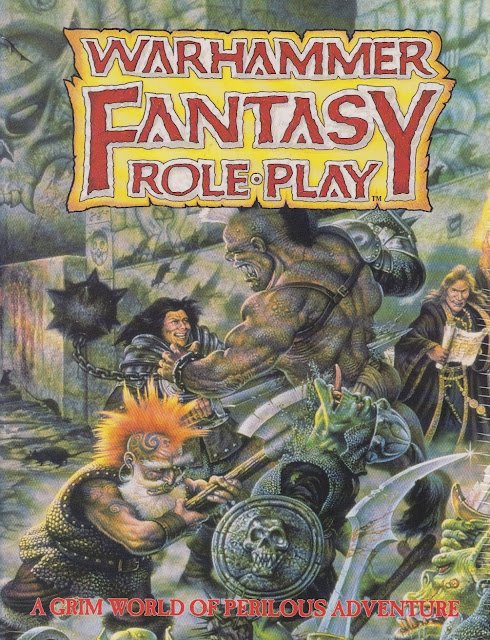

Warhammer Fantasy was my favorite game for a few years. Some aspects of it were not to my players liking so we continued with the world’s most popular role-playing game. Actually, we never stopped. It was high school and we could play four or five nights a week if we wanted and on weekends, we would have twelve-hour games sometimes. Warhammer Fantasy and Rolemaster were the ‘other’ games we played. Mostly my players wanted to be more heroic or have simpler games. I never understood the simpler part and a preference for Advanced Dungeons and Dragons. That was terribly complex game.

I really liked the wound system in Warhammer. In short, all characters only had a few wound points and getting in a fight could be fairly deadly. Much like Basic Dungeons and Dragons starting at 1st level back in the way back days of my youth. Combat became less lethal in Dungeons and Dragons as one advanced in levels. In Warhammer, combat stayed lethal because those wound points never really changed much. At least as I recall. I enjoyed that degree of lethality, not because I received some unnatural joy from watching player’s characters die, but because I never had a scalability problem and fights were not to be taken lightly.

Wounds also had a ‘real’ feeling to them. There was a chart showing where the wound was taken and how that wound might hamper a character’s ability to perform certain tasks. Hit points, on the other hand, don't do that for me. It is just a resource that one has to manage. Don’t get me wrong, hit points serve their purpose well and to date, that I know of, no one has come up with a simpler solution to address both combat and reward for advancement in one little rule. But it does have a scalability problem.
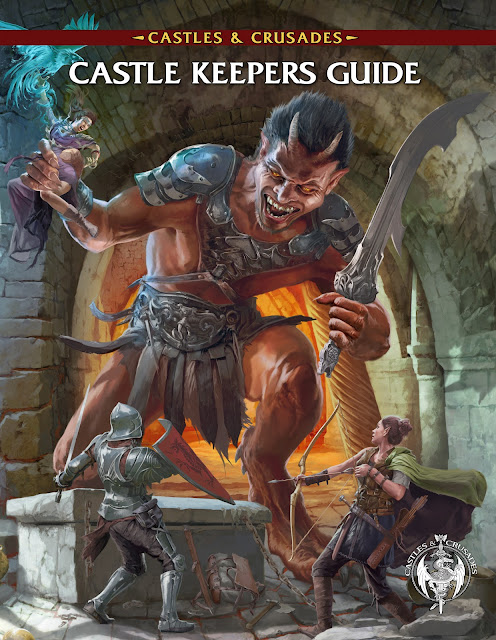
I like the idea of a wounded character suffering in combat or elsewhere because of the wound and that they might actually die. There is a mechanic in the Castle Keepers Guide. The rule layers wounds with hit points and hit locations. The problem here is that a rule like that creates four layers of damage; hit points, wounds, hit location, and effect. Few people want to keep up with that. That level of verisimilitude can become an agonizing grind at the table – especially if the Castle Keeper is using it for non-player characters and monsters.

All that said, it is important to reiterate that hit points do not represent wounds in Castles and Crusades. Hit points represent a combination of stamina, fighting skill, will, and other factors in and out of combat. When a character with 40 hit points takes 6 points of damage, they may be scratched or bruised, or may not. What does happen is that that character is beginning to wear out, their defensive moves worked around, and their will being sapped. As they take more damage, this all piles up until suddenly, after 40 hit points of damage they are done.

I like the idea that when a character’s initial hit points are determined, that is their wounds. As a character becomes more experienced, accustomed to pain, mentally powerful, and better at avoiding the sword thrusts and arrows of combat, actual wounds are not taken. Only as they become nearly exhausted and worn down do the characters take wounds. Yeah, the more I think about that idea, the more I like it.

Where’s my Castle Keeper Guide? 


Monday, January 24, 2022

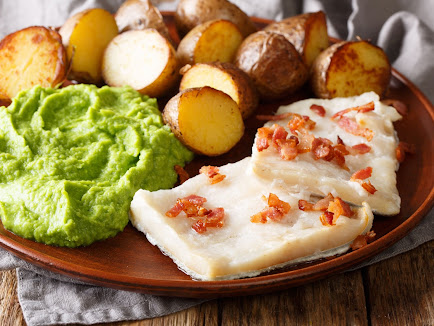
Word of the Day -- Lutefisk

This is one of those words that I'm not sure where I heard it first.  It's not something you normally come by unless you live in northern Europe:

Lutefisk -- dried codfish that has been soaked in a water and lye solution before cooking.

Preserved fish provided protein during the long winter months for generations in a part of the world with a strong fishing tradition. It is not known when people first started treating dried fish with lye. The reason was probably that the lack of major salt deposits in the area favored the drying process for the preservation of whitefish - a process known for millennia.


Magic is Horrible – Is there a Better Way


I have a veritable cornucopia of complaints about magic in almost every iteration of The Game in existence. Not so much that I have ever done anything about it but I still grumble about magic. Magic, as it is usually presented, is a potentially massive problem. Not only is this an in-game disaster waiting to happen, but from a meta-gaming or world building perspective, it can also a nightmare. 


How does magic work? We have no real world analogues to draw from so it has to be created from the bottom up. What role does magic play in the world setting?  How is magic supposed to be used in the game? (That from a game design perspective.) Is it a resource or something else? Combining the elements game design, setting, and the role of magic into something cohesive and workable is somewhat difficult.

That said, the Vancian magic system designed by Gary Gygax is a 100% functional in game utility. But and here is the big but, when one moves outside the game system’s designed use for magic and begin using it in settings and places for which it was not designed, we gets ourselves a problem. Most every iteration of The Game is, at its core, is a resource management game. Everything is a resource to gather more resources, be it gold or hit points. Fantastical elements are draped over this and boom, The Game.

Here is the thing though, resources are primarily spent and gathered in a closed systems (ie. dungeons). The magic resource is designed for that closed system. It is not designed to be used in say, world building (consider farming). If used judiciously one can make it work, but it takes a lot of shoe-horning. Just imagine the implications if that type of magic were real and widely (or even narrowly) used.

Lets take an example. Cure light wounds or similar is found in nearly every type of role-playing game imaginable. It is the stock spell for adventurers going into harms way. It preserves the hit point resource. But what if cure light wounds were used in the ‘world.’ It would more or less be like a Star Trek doctor bed thingy at every corner depending on the percentage of clerics one has per capita. The death rate would plummet and populations everywhere explode (or implode). Whole schools would be devoted to just learning that spell. A 12th level cleric could show up in a small town and essentially erase death from the life equation. And don’t get me going on creating food and water. Farming could become obsolete


One could limit magic in the setting by just reducing the number of those who can actually use magic. For example, only the topmost .001% of the population even have the capacity to use magic. (corrected - thanks Adam t nevertheless cannot resist saying that 0.1% is one in a thousand, and that 0.001% is one in a hundred thousand) . That would be one person in one thousand. Now if you spread those percentages out through all character classes, leveled NPCs, and start crunching numbers it all breaks down or become ridiculous.


This is because most magic systems are not built for world building. They are built for discreet enclosed encounters. And I am fine with that. The world building is just a place to set discreet encounters. I just talked myself into being OK with Vancian Magic. This is what happens at 2am. Now, on to each spell and reigning them in a bit because even in discreet encounters some are ridiculously overpowered. 

Or I could go with something different. Yeah, yeah, I'll do that because why not break what works

A Winter's Adventure

  Something haunts the river folk… It steals into homes and snatches the unwary, the weak, and the gentile. For those whom the horror does n...